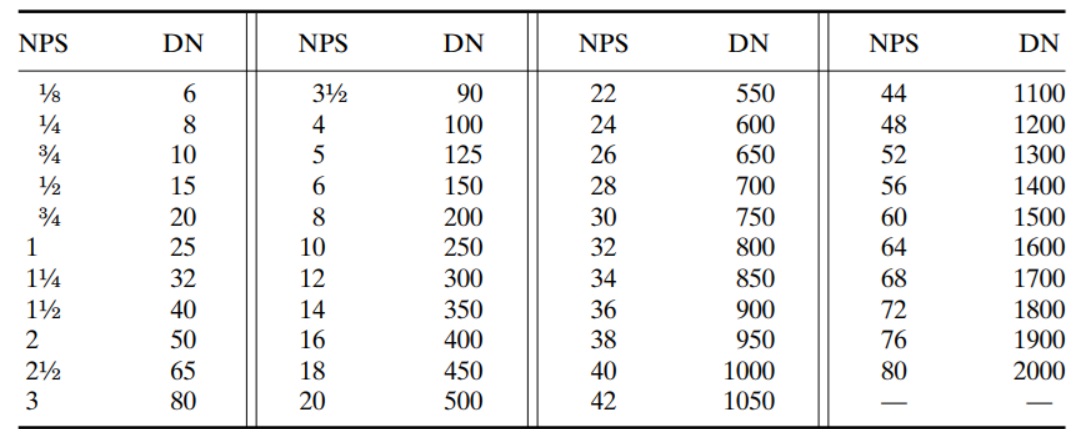
Nominal Pipe Size
Nominal Pipe Size is a north American set of standard sizes for pipes used
for high or low pressures and temperatures. The name NPS is based on the
earlier "Iron Pipe Size" (IPS System).
The IPS system was describing approximately the inside diameter of the Pipe
and each pipe size was being produced to have one thickness, which was termed
as standard (STD). Thus, the outside diameter was standarized as well.
As the pressure requirements were being increased the wall thickness was also
being increased giving the new types of extra strong (XS) and double extra strong (XXS).
So, the IPS has just 3 thickness values.
In 1927, the American standards Association created more steps between the IPS standard sized by
introducing the "Schedule" and nominal thickness (SCH 5, 5S, 10, 10S, 20, 30, 40, 40S, 60, 80, 80S, 100,
120, 140, 160, STD, XS and XXS).
Schedule 40 piping, no matter the diameter of the pipe, has 3/8″ walls.
Schedule 80 pipe has 1/2″ walls and conforms to the old “extra strong”.
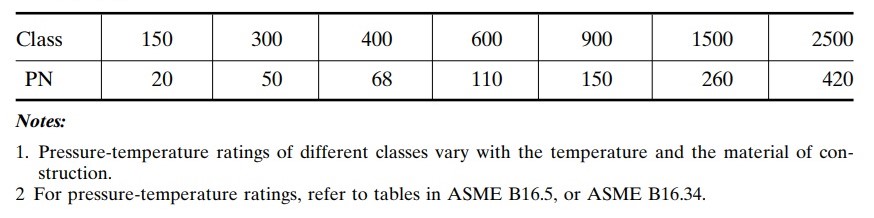
On the other hand Pipe Class means Pressure rating.
Schedule 40 and Class 200 have the same OD(Outside Diameter), but the Schedule 40 pipe will have a thicker inner wall
than the Class 200.
Schedule 80 pipe will be thicker than Schedule 40 pipe but will also have the same OD. What makes it
even nicer is that the Schedule 40 fittings you buy will fit all of these pipes, because all that is changing is the pipe
thickness and not the OD (Outside Diameter) of the pipe.
Nominal size is a term used for the comparative sizes of piping and tubing rather than the actual dimensions.
For a given NPS (Nominal Pipe Size), the OD stays fixed and the wall thickness increases with schedule.